By What Standard?
Credits are not available.
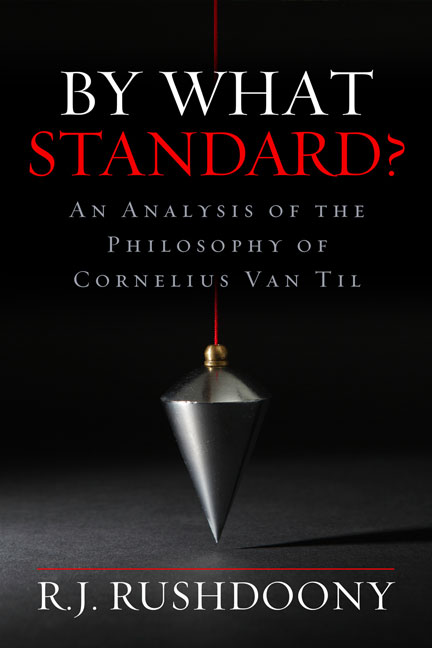
An introduction into the problems of Christian philosophy. It focuses on the philosophical system of Dr. Cornelius Van Til, which in turn is founded upon the presuppositions of an infallible revelation in the Bible and the necessity of Christian theology for all philosophy.
Basic to this study is the belief that presuppositions of human thought in every field must be basically one in order to arrive at any concept which both validates biblical faith and human knowledge. The sovereignty of the self-contained God is the key to every field, in that only the God of Scripture makes all things possible and explicable and is thus the basic premise not only of theology, but of philosophy, science and indeed all knowledge. In that God is the Creator of all things. He is their only valid principle of interpretation, in that they derive both their existence and meaning from His creative act. This belief is herein set forth in terms of various aspects of human thought.
Again basic to this study is the belief that such a philosophy finds consistent and able exposition in the writings of Cornelius Van Til. This work, therefore, is thus both an exposition as well of Van Til’s development of that philosophy, a school of thought to which the author subscribes.
This is Rushdoony’s foundational work on philosophy.
Libraries: Chalcedon Foundation Library
Available audio: 16 of 16 listed chapters. Full-book completeness is not established.
Chapters
Established chapter order; unnumbered chapters follow.
- Position 1
Foreword
- Position 2
Chapter 1: “Behold, it was Leah”
- Position 4
Chapter 3: “The Emperor Has No Clothes!”
- Position 8
Chapter 7: The Issue in Common Grace
- Position 10
Chapter 9: The Meaning of Inspiration
- Position 11
Chapter 10: Dictation and Inspiration
- Position 12
Chapter 11: The Authority of Scripture
- Position 13
Chapter 12: The Self-Contained God
- Position 14
Chapter 13: Christology and the Void
- Position 15
Chapter 14: How Wide a Gospel?
- Position 16
Appendices